
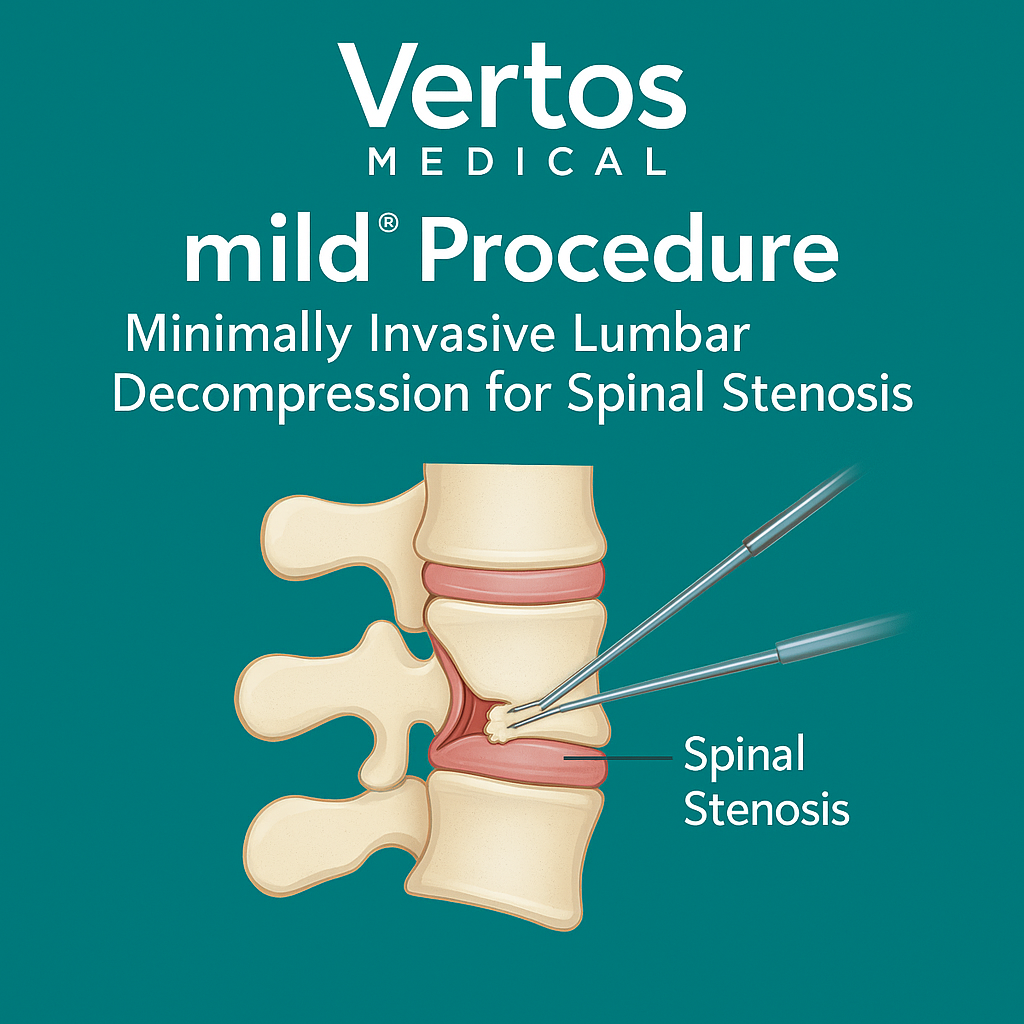
Vertos Medical mild® Procedure: Minimally Invasive Lumbar Decompression for Spinal Stenosis
Lumbar spinal stenosis (LSS) is a leading cause of lower back and leg pain in adults over 50, often resulting from thickened ligaments and bone overgrowth that narrow the spinal canal. It is prevalent in about 20% of patients aged 60 and older nationwide. The incidence of lumbar spinal stenosis is increasing due to an aging population and increasing physical activity leading to more wear and tear on the spine. When conservative treatments fail, patients may consider decompressive surgery.
Vertos Medical is an interventional pain company committed to developing innovative, minimally invasive treatments for lumbar spinal stenosis.
The company utilizes proprietary technology in the mild® Procedure, which is performed under the leadership of the group president who drives innovation at Vertos Medical.
Stryker has acquired Vertos Medical, expanding its interventional pain management solutions.
The mild® Procedure offers a less invasive option that removes excess ligament tissue through an incision smaller than the size of a baby aspirin, to relieve pressure on nerves without a hospital stay.
Introduction to Lumbar Spinal Stenosis (LSS)
Lumbar spinal stenosis (LSS) is a condition where the spinal canal in the lower back becomes narrowed, putting pressure on the spinal nerves.
This narrowing can lead to chronic lower back pain, leg pain, and sensations such as numbness or tingling in the legs and buttocks.
LSS may be present from birth (congenital) or develop over time due to age-related changes, such as thickening of ligaments or bone overgrowth. Symptoms often worsen when standing or walking and may improve when sitting or bending forward.
Diagnosis typically involves imaging tests like X-rays, CT scans, or MRIs to assess the degree of spinal stenosis and its impact on the spinal nerves.
Treatment options for lumbar spinal stenosis range from conservative therapies—including physical therapy and epidural steroid injections—to minimally invasive procedures like the mild procedure.
In more severe cases, surgical intervention may be necessary. Understanding the causes, symptoms, and available treatment options is essential for managing LSS and finding relief from chronic lower back pain.
What is the mild® Procedure?
Developed by Vertos Medical, the mild (Minimally Invasive Lumbar Decompression) Procedure is a minimally invasive outpatient procedure designed to treat lumbar spinal stenosis caused by hypertrophic ligamentum flavum.
During the procedure, a 5.1 mm incision is made in the lower back. Through this tiny portal, specialized instruments are used to remove portions of the thickened ligament and restore space in the spinal canal.
The procedure is guided by fluoroscopy, a type of real-time X-ray. The MILD procedure can be performed using local anesthetic and light sedation.
This minimally invasive procedure does not require implants or general anesthesia, and patients typically go home the same day.
The mild Procedure has been clinically demonstrated to be safe and effective. It is considered an early intervention when conservative therapies have failed but before more invasive surgery is warranted.
How does the mild® Procedure work?
The procedure is performed under fluoroscopic guidance with the patient lying prone. Direct image review is used during fluoroscopy to accurately target the affected area and optimize clinical outcomes.
After local anesthesia and light sedation, the surgeon introduces instruments through the small incision to excise excess ligament tissue.
The mild® procedure allows patients to communicate with the doctor during the procedure due to the use of topical anesthesia. Because only soft tissue is removed, bone and muscle structures remain intact, preserving spinal stability.
The incision is closed with a single suture or adhesive strip, and patients are encouraged to walk shortly after. The entire process usually takes less than an hour.
Main Benefits
Studies have shown that the mild procedure provides patient significant pain relief and functional improvement. Participants increased their standing time from 8 to 56 minutes and their walking distance from 246 feet to nearly 4,000 feet one year after treatment.
Such a significant outcome demonstrates the effectiveness of the procedure. Long-term data indicate that 88% of patients avoided back surgery for at least five years.
The mild® procedure has been shown to have a safety profile equivalent to epidural steroid injections with durability out to 5 years.
Because the procedure is minimally invasive, risks are lower than with open surgery, and recovery is quick; patients typically return to normal activities within 24 hours.
Many patients report better sleep and the ability to resume an active life following the procedure. This significant outcome highlights the improvements seen in patients.
Technical Specifications
Illustration of the mild® Procedure
Specification | Details |
Incision size | 5.1 mm portal |
Tissue removed | Portion of hypertrophic ligamentum flavum |
Procedure length | Typically under 1 hour |
Hospital stay | Outpatient |
Clinical outcomes | In LSS patients, standing time increased |
Long‑term results | 88 % of LSS patients avoided back surgery |
Specification
Details
Incision size
5.1 mm portal
Tissue removed
Portion of hypertrophic ligamentum flavum
Procedure length
Typically under 1 hour
Hospital stay
Outpatient
Clinical outcomes
In LSS patients, standing time increased
from 8 to 56 minutes; walking distance from
46 ft to 3 956 ft after 1 year
Long‑term results
88 % of LSS patients avoided back surgery
for at least 5 years
The mild® Procedure is one of several minimally invasive treatments available for lumbar spinal stenosis, offering a safe, outpatient option with quick recovery compared to traditional surgery.
Alternative Treatments for Lumbar Spinal Stenosis
When it comes to managing lumbar spinal stenosis, patients have several treatment options to consider. Conservative therapies are often the first step and may include physical therapy to improve strength and flexibility, pain management medications, and epidural steroid injections to reduce inflammation and provide temporary pain relief.
These approaches aim to help patients maintain mobility and manage chronic lower back pain without surgery. For those who do not experience adequate relief from conservative therapies, minimally invasive procedures offer a next step.
The mild procedure is one such minimally invasive treatment that targets the major root cause of LSS by removing excess ligament tissue and relieving pressure on the spinal nerves, resulting in lasting relief.
Other options may include endoscopic spinal decompression or the implantation of a Superion Interspinous Spacer, which can help maintain space in the spinal canal.
It is important for patients to work closely with their healthcare provider to review all treatment options and select the approach that best addresses their specific symptoms and lifestyle needs.
What to Expect During the Procedure
The mild procedure is a minimally invasive, image-guided outpatient procedure designed to treat lumbar spinal stenosis safely and effectively.
On the day of the procedure, patients are positioned facedown, and the area is numbed with topical anesthesia, allowing them to remain awake and communicate with the care team throughout.
Using real-time X-ray guidance, the physician inserts a needle into the lower back and injects a contrast dye to clearly identify the affected region.
A small incision—typically smaller than a baby aspirin—is made to insert a specialized port. Through this port, instruments are used to remove the excess ligament or bone tissue that is compressing the spinal nerves.
The entire process usually takes about an hour, and because it is an outpatient procedure, patients can return home the same day.
Before the procedure, patients should inform their doctor about any medications they are taking and any allergies to dyes or medications. It is also important to arrange for someone to drive them home after the procedure.
Recovery and Aftercare
Recovery from the mild procedure is typically quick and straightforward. Most patients experience significant improvement in pain and mobility within a few days and can return to their normal activities—often within 24 hours.
Recovery from the mild® procedure generally takes a few days, after which patients should notice an improvement in pain levels.
During the initial recovery period, it is important to avoid heavy lifting and strenuous activities to allow the body to heal.
Patients should follow all post-procedure instructions provided by their healthcare team, including taking any prescribed medications, attending follow-up appointments, and monitoring for signs of infection or worsening symptoms.
With proper aftercare, patients can achieve lasting relief from chronic lower back pain and enjoy a more active lifestyle.
The mild procedure is designed to help patients regain function and reduce pain, supporting a return to daily activities and improved quality of life.
Risks and Complications
Although the mild procedure is a minimally invasive treatment with a strong safety profile, as with any medical procedure, there are potential risks and complications.
These may include infection, nerve damage, or an allergic reaction to the contrast dye used during the procedure. However, clinical studies have demonstrated that the safety profile of the mild procedure is equivalent to that of epidural steroid injections, and the risk of complications is generally low.
The incision made during the procedure is typically smaller than a baby aspirin, which further reduces the risk compared to more invasive surgical options.
Patients should discuss their individual risk factors and any concerns with their healthcare provider to make an informed decision about their treatment options.
By understanding the potential risks and working closely with their care team, patients can confidently pursue the best path to pain relief and improved function.
Comparison with Competitors
Traditional laminectomy or fusion surgeries involve removing bone and may require hospitalisation and lengthy recovery. In contrast, mild removes only excess ligament tissue, preserving stability and allowing rapid return to activity.
Epidural steroid injections offer temporary relief but do not address the underlying stenosis. The mild procedure fits between conservative care and open surgery, providing durable symptom relief with lower risk.
The mild® Procedure provides long-term relief of symptoms such as pain, numbness, and tingling in the lower back and legs.
The mild Procedure is an option for lumbar spinal stenosis (LSS) patients who are not surgical candidates, offering a minimally invasive alternative for those who may not be suitable for traditional surgery.
It is part of the broader field of interventional pain management, focusing on specialized, minimally invasive treatments.
Additionally, the mild Procedure is nationally covered by major insurance programs, including Medicare, making it accessible to patients across the country.
User Testimonials and Reviews
Patients frequently report dramatic improvements in their ability to stand, walk and perform daily tasks after the mild procedure.
Sherry underwent the mild Procedure for her chronic lower back pain and was amazed at how easy the process was and how quickly she regained her mobility, enjoying a much-improved quality of life.
Paul’s physician used the mild Procedure to precisely target his lumbar spinal stenosis, resulting in significant pain relief and a return to his favorite activities.
The mild Procedure elevates LSS patients by improving their quality of life, offering pain relief and greater functional ability.
Many appreciate that recovery is quick and that they can avoid more invasive surgery, thanks in large part to the support and expertise of fantastic team members who guide patients through every step of their treatment journey. However, outcomes vary based on the severity of stenosis and patient health.
Where to Buy and Pricing
The mild procedure is performed by healthcare providers, including interventional pain specialists and spine surgeons. These healthcare providers play a crucial role in delivering minimally invasive treatments for patients with lumbar spinal stenosis who have not responded to conservative therapy.
The Vertos team is dedicated to supporting both patients and healthcare providers throughout the care process. Insurance coverage is increasingly common but should be confirmed in advance. Contact our affiliate clinic for an evaluation.
Frequently Asked Questions
How soon can I return to normal activities?
Most patients resume light activities within 24 hours and progressively increase activity as tolerated.
Will I need physical therapy?
Physical therapy is often recommended after the procedure to build strength and maximise long‑term results.
Is mild covered by insurance?
Coverage varies by insurer and country; many plans now reimburse the procedure. Check with your provider.
How does mild compare with epidural injections?
Epidural injections reduce inflammation temporarily, whereas mild removes excess ligament tissue to create lasting decompression. Clinical studies published in Pain Pract support the effectiveness of the mild Procedure for lumbar spinal stenosis.
Conclusion
The mild procedure provides a proven, minimally invasive option for patients with lumbar spinal stenosis seeking to relieve pain, improve walking distance and avoid open surgery. If you’re considering treatment for LSS, consult with a specialist to determine whether mild could help you regain mobility and quality of life.


